The Infrastructure Problem Most AI Projects Don't Survive
Most Australian enterprises approach AI adoption backwards. They select a use case, procure a cloud service, and bolt it onto existing infrastructure - then wonder why costs spiral and performance disappoints. The result is AI that works in demos but fails in production. The enterprises that avoid this trap share one characteristic: they build infrastructure to support AI from the ground up, not as an afterthought.
This is where AI implementation services Australia-wide are evolving fastest. The conversation has shifted from "which model should we use?" to "what infrastructure decisions will determine whether this actually works at scale?" Two unlikely sources - railway engineering principles and the open-source software movement - offer the clearest frameworks for getting this right.
What "AI-Native" Infrastructure Actually Means
AI-native infrastructure is an architecture designed from the outset to support machine learning workloads, inference pipelines, and continuous model iteration - rather than general-purpose computing retrofitted to handle AI tasks. This is distinct from simply running AI workloads on existing cloud infrastructure.
Traditional enterprise infrastructure optimises for consistent, predictable workloads: a web server handling HTTP requests, a database processing transactions. AI workloads behave differently. They are bursty, memory-intensive, often GPU-dependent, and require fast access to large datasets. An infrastructure layer that treats a 70-billion-parameter language model inference request the same as a REST API call will either overspend dramatically or underperform consistently.
The practical difference shows up in three areas:
- Compute scheduling: AI workloads benefit from GPU-aware orchestration (Kubernetes with GPU node pools, or dedicated inference servers like Triton or vLLM)
- Data locality: Models perform better when training and inference data sits close to compute - minimising latency between storage and GPU memory
- Observability: AI systems require different monitoring than traditional software - tracking token throughput, model drift, and inference latency, not just CPU and memory
The Railway Principle: Design for Reliability Before Speed
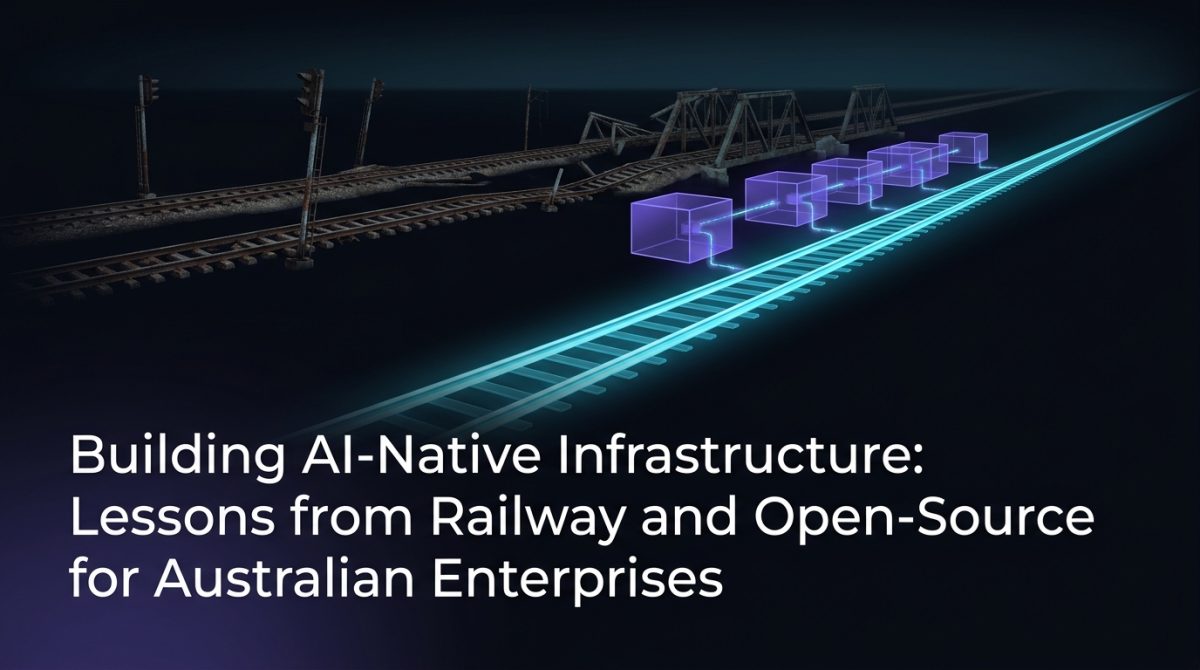
Railway engineering has a rule that applies directly to AI infrastructure: you build reliable track before you run fast trains. Speed without reliability produces disasters. The same logic applies to AI deployment.
The most common failure mode in enterprise AI projects is prioritising capability over reliability. Organisations deploy large, powerful models on under-engineered infrastructure, then discover that a single dependency failure - a cloud API outage, a model version change, a network partition - takes down business-critical workflows.
Applying railway principles to AI infrastructure means:
- Define your failure modes before you build. Map every external dependency in your AI pipeline. For each one, ask: what happens to the business if this is unavailable for two hours? Four hours? A day?
- Build circuit breakers into inference pipelines. If your primary model endpoint fails, your system should automatically fall back to a smaller local model or a cached response - not return a 500 error to users.
- Separate your training and inference infrastructure. These have different reliability requirements. Training can tolerate interruptions; inference serving often cannot.
- Version everything. Model weights, prompts, pre-processing code, and post-processing logic should all be version-controlled and deployable independently.
- Test degraded states regularly. Schedule monthly failure simulations. Pull a GPU node offline. Throttle your vector database. Verify that your fallback paths actually work.
A Queensland logistics company running route optimisation on a local LLM learned this the hard way. Their initial deployment ran a single Ollama instance on a cloud VM. When that VM required maintenance, their dispatch system was unavailable for six hours. After rebuilding with a primary/replica setup and a lightweight fallback model, their uptime improved from 94% to 99.7% - and their infrastructure cost actually decreased because they replaced an oversized single instance with two appropriately-sized nodes.
Open-Source AI: The Cost-Effective Path for Australian Enterprises
Open-source AI tools reduce total infrastructure cost by 40-70% compared to equivalent proprietary API-based approaches for sustained production workloads. This is not a theoretical saving - it reflects the difference between per-token API pricing and the fixed cost of running local models on owned or leased compute.
The open-source AI ecosystem has matured significantly. For Australian enterprises evaluating ai-native cloud versus on-premises or hybrid approaches, the relevant tools now include:
Local LLMs and inference servers:
- Ollama - straightforward local model deployment, suitable for development and lower-throughput production
- vLLM - high-throughput inference server with PagedAttention for efficient GPU memory use
- llama.cpp - CPU-based inference for environments without GPU access
Orchestration and pipelines:
- LangChain / LlamaIndex - document retrieval and agent orchestration
- Apache Airflow - workflow scheduling for data pipelines feeding AI systems
- Prefect - modern alternative to Airflow with better observability
Vector databases:
- Qdrant - self-hostable, performant for semantic search at scale
- Weaviate - strong schema support and hybrid search capability
A practical deployment for a mid-sized Australian professional services firm might look like this:
# Simplified stack overview
inference:
  primary: vLLM serving Mistral-7B-Instruct on 2x A10G GPUs
  fallback: Ollama serving Phi-3-mini on CPU

retrieval:
  vector_db: Qdrant (self-hosted, 3-node cluster)
  embedding_model: nomic-embed-text (local)

orchestration:
  pipelines: Prefect Cloud (managed)
  api_gateway: FastAPI + Redis cache

observability:
  metrics: Prometheus + Grafana
  tracing: OpenTelemetry → Jaeger
This stack handles roughly 500 concurrent users, costs approximately $2,800/month in infrastructure, and processes documents without sending sensitive client data to external APIs - a significant compliance advantage for legal, financial, and healthcare sectors.
Data Sovereignty and the Australian Compliance Case for Local Deployment
Australian enterprises operating under the Privacy Act 1988, the Australian Privacy Principles, and sector-specific regulations (APRA CPS 234 for financial services, My Health Records Act for healthcare) face real constraints on where data can be processed. Sending sensitive documents to offshore API endpoints introduces compliance risk that many legal and risk teams are not comfortable accepting.
Local LLMs eliminate this risk entirely. When inference runs on infrastructure you control - whether on-premises or in an Australian data centre - data never leaves your environment. This is not a minor consideration; it is a material compliance advantage that justifies infrastructure investment independently of cost savings.
For cloud migration Australia projects that include AI workloads, this means evaluating Australian-region availability carefully. AWS ap-southeast-2 (Sydney), Azure Australia East, and Google Cloud australia-southeast1 all support GPU instances, but capacity constraints are real and lead times for reserved GPU instances can exceed three months. Planning infrastructure procurement 6-12 months ahead of production deployment is not overcautious - it is operationally necessary.
How to Evaluate Your Current Infrastructure Readiness
Assessing AI infrastructure readiness takes approximately two weeks for a mid-sized enterprise and produces a clear gap analysis. Here is the process we use when engaging with clients seeking AI implementation services in Australia:
- Inventory existing compute and network. Document current cloud spend by service, identify GPU-capable instances already provisioned, and measure network latency between key data stores and compute nodes.
- Map data flows for target AI use cases. For each use case, trace where data originates, what processing it requires, and where outputs are consumed. Identify every external API call in the path.
- Assess data classification. Categorise data by sensitivity. Anything classified as personal information, commercially sensitive, or regulated should be flagged for local processing evaluation.
- Benchmark inference requirements. Run load tests against candidate models at projected production volumes. Measure p50, p95, and p99 latency. Identify the minimum hardware tier that meets your SLA.
- Calculate total cost of ownership. Compare API-based and self-hosted options over a 24-month horizon. Include GPU instance costs, engineering time for maintenance, and the cost of downtime at your projected usage volume.
- Identify quick wins. Most enterprises find 2-3 use cases where switching from API-based to local inference reduces cost by more than 50% with minimal re-engineering effort.
This assessment directly informs infrastructure architecture decisions and prevents the most common mistake in enterprise AI projects: over-engineering for hypothetical future scale while under-engineering for present reliability.
What to Do Next
If your organisation is planning AI deployment or has existing AI workloads that are underperforming or over-budget, the infrastructure layer is where to start. Capability decisions made at the model selection stage are largely reversible. Infrastructure decisions - particularly around data architecture and compute procurement - are not.
Exponential Tech provides AI implementation services across Australia, including infrastructure assessment, local LLM deployment, and production pipeline engineering. We work with enterprises that need AI to function reliably in regulated environments, not just demonstrate well in proof-of-concept.
If you want a concrete starting point, run the six-step readiness assessment above and document your findings. If you want support doing it rigorously and translating the output into an actionable architecture, get in touch.
Frequently Asked Questions
Q: What is AI-native infrastructure?
AI-native infrastructure refers to an architecture designed from the ground up to support machine learning workloads, inference pipelines, and model iteration - rather than general-purpose computing infrastructure retrofitted to handle AI tasks. It differs from standard cloud infrastructure in its handling of GPU scheduling, data locality, and AI-specific observability requirements.
Q: How much does it cost to run local LLMs in production for an Australian enterprise?
A production-grade local LLM deployment for a mid-sized Australian enterprise typically costs between $2,500 and $5,000 per month in infrastructure, depending on model size and concurrent user load. This compares to $8,000-$15,000 per month for equivalent throughput via commercial API providers at sustained production volumes, representing a 40-70% cost reduction over a 24-month horizon.
Q: What are the data sovereignty requirements for AI in Australia?
Australian enterprises must comply with the Privacy Act 1988 and the Australian Privacy Principles, which restrict how personal information is handled and transferred offshore. Sector-specific regulations including APRA CPS 234 (financial services) and the My Health Records Act (healthcare) impose additional constraints. Running AI inference on locally-hosted infrastructure eliminates offshore data transfer risk and is the most straightforward path to compliance for sensitive workloads.
Q: How do I choose between cloud-based and on-premises AI infrastructure in Australia?
The decision depends on three factors: data sensitivity, workload volume, and GPU availability. Sensitive or regulated data workloads should default to local or Australian-region cloud deployment. High-volume sustained workloads (more than 10 million tokens per day) are almost always cheaper to run on owned or reserved compute than via pay-per-token APIs. GPU capacity constraints in Australian cloud regions mean procurement lead times of 3-6 months for reserved instances, which should be factored into any cloud migration timeline.