The Real Cost of Getting This Decision Wrong
Your development team is spending 30% of their time on boilerplate code. Someone suggests an AI coding agent. The vendor demo looks impressive. You're about to sign a contract that locks your intellectual property, your codebase metadata, and your team's prompting patterns into a proprietary system you don't control.
This is the decision point where ai strategy consulting australia pays for itself - and where most enterprises get it badly wrong.
The choice between open source and proprietary AI coding agents is not a technology question. It is a data governance question, a cost structure question, and a competitive moat question. Getting it right requires understanding what each model actually does with your code, your prompts, and your team's behaviour.
What "Open Source" and "Proprietary" Actually Mean in This Context
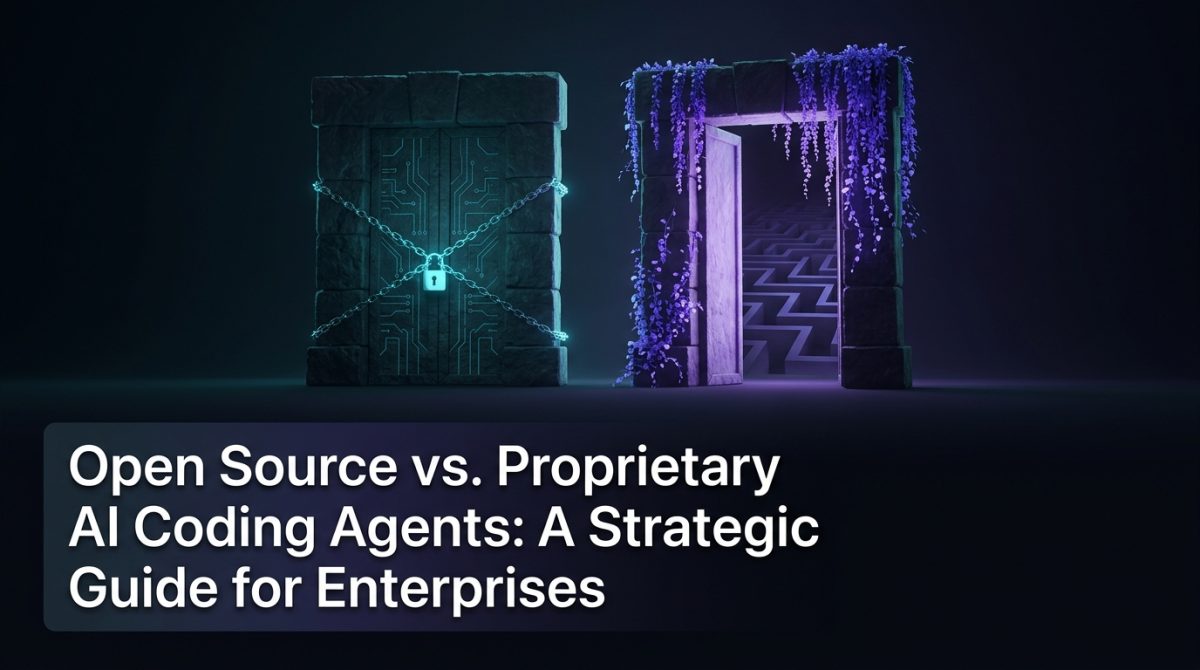
Open source AI coding agents refer to tools built on publicly auditable model weights and codebases, where the inference runs on infrastructure you control. Proprietary AI coding agents are commercial tools where the model, the infrastructure, and often the training pipeline are owned and operated by a third party, with your usage governed by their terms of service.
This distinction matters enormously in practice. When you use a proprietary coding agent - whether that's GitHub Copilot, Cursor with a cloud backend, or a Claude Code alternative built on a third-party API - your code snippets, file structures, and context windows are transmitted to external servers. Whether that data is used for training, retained for a period, or inspected by vendor staff depends entirely on the specific tier you're paying for and the fine print of your agreement.
Open source tools like Continue.dev, Tabby, or a self-hosted Ollama stack running models such as Qwen2.5-Coder or DeepSeek-Coder-V2 keep inference entirely on-premise or within your own cloud tenancy. The trade-off is infrastructure overhead and, in some cases, a capability gap - though that gap has narrowed significantly in the past 12 months.
The Privacy and Compliance Calculus for Australian Enterprises
Enterprise AI privacy is not an abstract concern - it is a compliance obligation with specific legal teeth in Australia.
The Australian Privacy Act 1988, the Notifiable Data Breaches scheme, and sector-specific frameworks like APRA CPS 234 all create obligations around how personal and sensitive data is handled. If your development team is working on systems that process health records, financial data, or government information, transmitting code context to a US-based SaaS vendor creates a cross-border data flow that requires explicit assessment under APP 8.
The practical implication: any enterprise operating in regulated sectors - financial services, healthcare, defence supply chain, government - should default to local LLMs for AI-assisted development unless they have completed a formal Privacy Impact Assessment and obtained appropriate contractual protections from the vendor.
Local LLMs running on AWS Sydney, Azure Australia East, or on-premise GPU infrastructure eliminate this exposure entirely. A self-hosted Ollama deployment running a quantised Qwen2.5-Coder-32B model on a single A100 node delivers code completion and generation quality that is competitive with mid-tier proprietary tools, with zero data leaving your environment.
Cost Structure: What the Vendor Pricing Pages Don't Show You
AI development costs for coding agents have two components that most procurement teams underestimate: per-seat licensing and context window consumption.
Proprietary tools like GitHub Copilot Enterprise run at approximately USD $39 per user per month. At 50 developers, that is USD $23,400 per year before any enterprise negotiation. Cursor Pro runs at USD $20 per month per seat. These figures are predictable - but they scale linearly with headcount and do not account for the additional API costs when agents are configured to use external model endpoints for complex reasoning tasks.
Open source alternatives have a different cost profile. The infrastructure cost for a self-hosted coding agent stack - a 4× A100 80GB node running Tabby or a Continue.dev backend, with model weights for Qwen2.5-Coder-32B - runs at approximately AUD $8,000-$12,000 per month on AWS or Azure, depending on reserved instance pricing. At 50 developers, that is roughly AUD $2,400 per developer per year, comparable to proprietary tools - but the cost does not scale with headcount beyond the capacity of the node.
At 100+ developers, the open source stack becomes materially cheaper. At 20 developers, proprietary tools often win on total cost of ownership when you factor in the engineering time required to maintain the self-hosted stack.
The break-even calculation:
Break-even headcount = (Monthly infra cost) / (Monthly per-seat cost)

Example:
AUD $10,000/month infra ÷ AUD $55/seat/month (Copilot Enterprise converted)
= ~182 seats

Below 182 seats: proprietary tools likely cheaper on TCO
Above 182 seats: open source stack likely cheaper
This is a simplified model. Factor in your DevOps team's capacity to maintain the stack, the cost of model updates, and the value of the data governance benefits before making a final call.
How to Evaluate AI Coding Agents for Enterprise Deployment
Selecting the right AI coding agent requires a structured evaluation process, not a vendor bake-off based on demo impressions.
-
Define your data classification requirements first. Identify which codebases contain proprietary algorithms, personal data, or regulated information. These repositories must be evaluated separately from general-purpose tooling decisions.
-
Run a capability benchmark on your actual codebase. Generic benchmarks like HumanEval or SWE-bench do not reflect your stack. Set up a controlled test with 10-15 representative tasks from your backlog - bug fixes, refactoring, test generation - and score each tool against your own rubric.
-
Assess IDE and workflow integration. A coding agent that requires developers to leave their existing IDE adds friction that reduces adoption. Continue.dev integrates with VS Code and JetBrains IDEs and supports local model backends. Tabby offers a self-hosted REST API that integrates with most editors.
-
Evaluate model update cadence and support. Proprietary tools update silently; open source models require you to manage updates. Establish a model governance process: who approves a new model version, how is regression testing handled, and what is the rollback procedure.
-
Pilot with a single team for 60 days. Measure velocity metrics (pull request cycle time, lines of code reviewed per hour), defect rates, and developer satisfaction. Do not rely on self-reported productivity gains - pull the data from your version control system.
-
Review the vendor's data processing agreement or confirm your infrastructure isolation. For proprietary tools, obtain a signed Data Processing Agreement that explicitly prohibits training on your data. For open source stacks, document your network isolation controls as evidence for your next compliance audit.
A Scenario: How a Mid-Sized Fintech Made the Call
A Brisbane-based fintech with 65 developers was evaluating AI coding tools in early 2024. Their codebase included payment processing logic and customer financial data. Initial enthusiasm for a popular proprietary tool stalled when their legal team reviewed the vendor's data retention terms - specifically, a clause permitting the vendor to retain prompt data for up to 30 days for "service improvement."
They engaged an AI strategy consulting australia firm to structure the evaluation. The outcome was a hybrid architecture: a self-hosted Continue.dev backend running Qwen2.5-Coder-32B on two A100 nodes in AWS Sydney for their core financial systems, and a negotiated GitHub Copilot Enterprise agreement (with a custom DPA) for their front-end and internal tooling teams who worked with non-sensitive code.
The result: full APRA CPS 234 compliance, a 22% reduction in pull request cycle time across both teams at the 90-day mark, and a total cost that was 18% lower than deploying proprietary tools across all 65 seats.
The lesson is not that open source always wins. It is that the decision requires a structured framework, not a preference.
What to Do Next
If your organisation is evaluating AI coding agents - or has already deployed one without a formal data governance review - these are the immediate actions that matter:
- Audit your current tool usage. Identify every AI coding tool in use across your development teams, including personal accounts that developers may have connected to work repositories.
- Classify your codebases. Determine which repositories contain regulated data, proprietary algorithms, or information subject to contractual confidentiality obligations.
- Run the break-even calculation. Use the formula above with your actual headcount and infrastructure costs to establish whether open source or proprietary tools are economically rational for your scale.
- Engage specialist advice before signing enterprise agreements. Vendor contracts for AI tools contain terms that have real compliance implications. Get them reviewed.
If you want a structured process for making this decision - one that accounts for your regulatory environment, your team's technical capacity, and your actual cost structure - our team at Exponential Tech works with Australian enterprises on exactly this kind of evaluation. Visit our services page to see how we structure AI strategy engagements.
Frequently Asked Questions
Q: What is the difference between open source and proprietary AI coding agents?
Open source AI coding agents run on publicly available model weights and infrastructure that you control, meaning your code never leaves your environment. Proprietary AI coding agents are commercial tools operated by third-party vendors, where your code context is transmitted to external servers under the vendor's data terms.
Q: Are local LLMs good enough to replace proprietary coding tools like GitHub Copilot?
For most enterprise development tasks, current open source models such as Qwen2.5-Coder-32B and DeepSeek-Coder-V2 perform within 5-10% of leading proprietary tools on standard benchmarks. For regulated industries where data cannot leave the organisation, local LLMs are not just good enough - they are the only compliant option.
Q: How does AI strategy consulting in Australia help with this decision?
AI strategy consulting in Australia provides a structured evaluation framework that accounts for Australian privacy law, sector-specific compliance requirements such as APRA CPS 234, and the total cost of ownership across both open source and proprietary options. It replaces ad hoc vendor selection with a documented, defensible decision process.
Q: What are the main risks of using proprietary AI coding agents without a formal review?
The main risks are data sovereignty exposure (your code being retained or processed offshore), vendor lock-in that limits your ability to switch tools, unpredictable cost scaling as headcount grows, and compliance gaps that may not surface until an audit. A formal review before deployment addresses all four risks with documented controls.