The Gap Between Data and Action
Most AI projects fail quietly. Not because the models are wrong, but because the plumbing is broken.
An e-commerce business trains a solid recommendation engine. A logistics company builds a genuinely useful demand forecasting model. A financial services firm deploys a fraud detection system that works well in testing. Then they wire these systems into their existing architecture using synchronous API calls, scheduled batch jobs, and direct database polling - and the whole thing falls apart under real operating conditions.
The model that took three months to build sits idle because the data it needs arrives late, out of order, or not at all. The business problem gets worse, not better.
This is an infrastructure problem, not an AI problem. And the solution is event-driven ai architecture - a pattern where systems react to things that happen rather than periodically checking whether something has changed.
What Event-Driven Architecture Actually Means
The core idea is simple. Instead of Service A asking Service B "do you have anything new for me?" on a schedule, Service B announces "something happened" the moment it occurs. Subscribers receive that announcement and act on it immediately.
The three components you need to understand are:
- Events - a record that something happened, with a timestamp and relevant data payload (a purchase was made, a sensor reading exceeded a threshold, a document was uploaded)
- Message queues - durable buffers that hold events until a consumer is ready to process them (AWS SQS, Azure Service Bus, RabbitMQ)
- Webhooks - HTTP callbacks that push event notifications to a registered endpoint the moment they occur
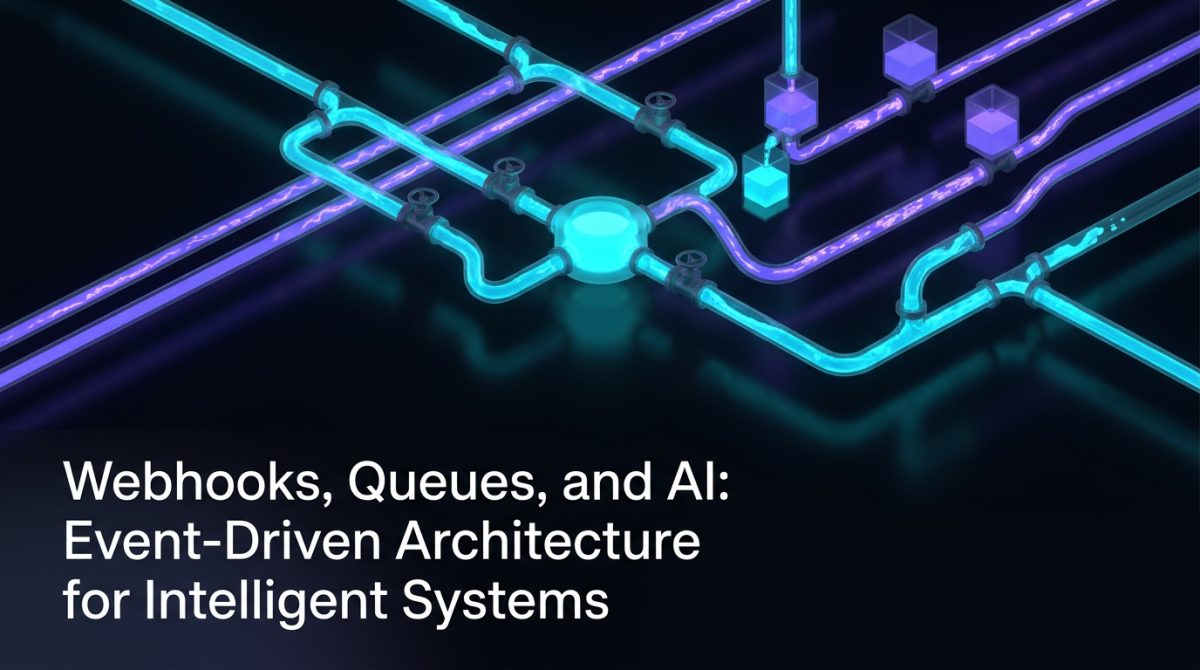
These work together. A webhook fires when a customer completes a checkout. That HTTP request lands in a queue. Your AI inference service picks up the queued message, runs a recommendation model, and writes personalised upsell content back to the order management system - all within seconds, without any scheduled job or polling loop.
The practical difference for AI workloads is significant. Batch processing introduces latency. A fraud detection model that runs every 15 minutes is not a fraud detection model - it is a fraud reporting model. Event-driven ai architecture makes real-time inference operationally viable.
Webhooks: The Front Door for External Events
Webhooks are how external systems tell your platform that something has changed. Payment processors, CRMs, e-commerce platforms, IoT devices, and third-party SaaS tools all support them.
The mechanics are straightforward. You register a URL endpoint with the external system. When a defined event occurs - a payment succeeds, a form is submitted, a device sends a reading - the external system sends an HTTP POST request to your endpoint with a JSON payload describing what happened.
A few things matter when building webhook receivers for AI pipelines:
Respond fast, process later. Your endpoint should return a 200 OK within 2-3 seconds. If your inference job takes longer (and it often will), acknowledge receipt immediately and push the payload to a queue for asynchronous processing. Webhook senders that time out will retry, which creates duplicate events and downstream chaos.
Validate signatures. Most webhook providers include a signature header (Stripe uses Stripe-Signature, GitHub uses X-Hub-Signature-256). Verify this before processing anything. An unverified webhook endpoint is an open door.
Handle duplicates. Webhook delivery is typically "at least once", not "exactly once". Your processing logic needs to be idempotent - processing the same event twice should produce the same result as processing it once. Store event IDs and check for duplicates before triggering expensive model inference.
A concrete example: a property management company uses a CRM that fires a webhook whenever a prospective tenant submits an enquiry. The webhook hits a FastAPI endpoint, which immediately returns 200 and drops the payload into an SQS queue. A separate Lambda function consumes the queue, runs a lead scoring model, and updates the CRM record with a priority score - all within about 8 seconds of the original form submission. The leasing team sees scored leads in near real-time without any manual triage.
Message Queues: The Buffer That Keeps Everything Working
Queues decouple the systems that produce events from the systems that consume them. This decoupling is what makes event-driven ai architecture resilient.
Without a queue, your AI inference service must be available and responsive every time an event arrives. If the service is restarting, scaling up, or momentarily overloaded, events are lost. With a queue, events accumulate safely until the consumer is ready. Spikes in incoming volume do not cause failures - they cause the queue depth to grow temporarily.
Key queue concepts for AI workloads:
Dead letter queues (DLQs) catch messages that fail processing after a configured number of retries. If your model throws an exception on a malformed payload, the message moves to the DLQ rather than blocking the main queue. You can inspect, fix, and replay failed messages without losing data.
Visibility timeouts prevent duplicate processing. When a consumer picks up a message, the queue hides it from other consumers for a set period. If the consumer crashes before acknowledging completion, the message becomes visible again and another consumer picks it up. Set this timeout to comfortably exceed your model inference time.
FIFO vs standard queues - standard queues offer higher throughput but do not guarantee ordering. FIFO queues preserve order but have lower throughput limits. For most AI inference workloads, ordering does not matter and standard queues are the right choice. For event sourcing patterns where sequence matters (transaction processing, document version history), use FIFO.
A practical note on queue depth monitoring: set alerts when queue depth grows beyond a threshold that represents meaningful lag. If your queue is growing faster than your consumers are processing it, you either need more consumer instances or your model inference is slower than expected. Both are solvable, but only if you know it is happening.
Designing AI Inference Into the Event Flow
The interesting design question is where model inference sits in the event flow.
Synchronous inference at the webhook receiver works when the model is fast (under 500ms), the external system expects a response with the inference result, and you can tolerate coupling between the webhook handler and the model service. This is appropriate for simple classification tasks or lightweight scoring.
Asynchronous inference via queue works for everything else. The webhook handler writes to a queue, a separate inference service consumes from the queue, and results are written to a database or trigger a downstream event. This is the right pattern for anything involving large language models, image processing, or multi-step pipelines.
Event-driven ai architecture also supports model chaining. A document upload event triggers OCR extraction. The extraction result triggers entity recognition. The entity recognition result triggers a classification model. Each stage publishes its output as a new event. The pipeline is observable at every step, and individual stages can be reprocessed independently when models are updated.
This composability is practically valuable. When you retrain the classification model, you do not need to reprocess the OCR or entity recognition stages. You replay only the events that feed into classification.
Operational Concerns You Cannot Ignore
A well-designed event-driven system still fails if the operational fundamentals are wrong.
Schema management is the first thing that breaks as systems evolve. An AI pipeline that expects a customer_id field will fail silently if the upstream system renames it to customerId. Use a schema registry (Confluent Schema Registry for Kafka, AWS Glue Schema Registry for SQS/EventBridge) and enforce schema validation at the queue boundary. Fail loudly on schema violations rather than passing malformed data to your models.
Observability requires distributed tracing, not just logging. A single business event may flow through a webhook receiver, a queue, an inference service, a results database, and a notification service. Correlate all of these with a single trace ID that originates at the webhook and propagates through every downstream system. Without this, debugging production issues is extremely difficult.
Backpressure is what happens when your consumers cannot keep up with your producers. Queues buffer this temporarily, but unbounded queue growth eventually causes problems - increased latency, memory pressure, and cost. Design your consumers to scale horizontally based on queue depth, and set hard limits on queue retention periods so stale events do not accumulate indefinitely.
Cost is often overlooked during design. High-volume event streams with expensive model inference can generate significant compute costs quickly. Profile your inference costs per event early, and consider whether every event actually needs model processing or whether filtering at the queue level can reduce volume significantly.
A Worked Example: Real-Time Content Moderation
A media platform receives user-generated content across multiple channels - comments, uploads, live chat. They need to moderate content before it appears publicly, but manual review at scale is not viable.
The architecture works as follows. Each content submission fires a webhook to a FastAPI receiver, which validates the payload signature, assigns a trace ID, and publishes the event to an SQS queue. A fleet of ECS tasks consumes from the queue, runs a fine-tuned classification model to score content across several risk categories, and publishes the scored result to a second queue. A downstream service reads from the results queue and either approves the content for publication, holds it for human review, or automatically rejects it based on score thresholds.
The DLQ catches any payloads that cause inference failures. A CloudWatch alarm fires when DLQ depth exceeds 10 messages. The human review queue is monitored separately - if it grows beyond a threshold, the team is notified that the automated thresholds may need adjustment.
End-to-end latency from submission to moderation decision averages 4 seconds. The system handles traffic spikes without degradation because queue depth drives auto-scaling of the inference fleet. When the classification model is retrained, the team can replay a subset of historical events through the new model to validate performance before switching over.
This is event-driven ai architecture working as intended - reliable, observable, and operationally maintainable.
What to Do Next
If you are building AI capabilities into an existing system or designing a new one, start by mapping your current data flows and identifying where polling, scheduled jobs, or direct database reads are introducing latency or fragility.
Specifically:
- Audit your webhook endpoints - are they acknowledging fast and processing asynchronously? Are they validating signatures and handling duplicates?
- Review your queue configuration - do you have DLQs configured? Are visibility timeouts appropriate for your inference times?
- Add distributed tracing if you do not have it - a single trace ID across your entire event pipeline will save significant debugging time
- Profile inference costs per event before scaling - understand the unit economics before volume increases
If you are starting from scratch, choose a managed queue service (SQS, Azure Service Bus, or Google Pub/Sub) before evaluating more complex options like Kafka. Kafka is powerful but operationally demanding - most AI workloads do not need it initially.
Exponential Tech works with Australian organisations to design and implement production AI systems that hold up under real operating conditions. If your AI investment is not delivering because the infrastructure is not right, get in touch - we can help you work out where the gaps are and what to fix first.
Frequently Asked Questions
Q: What is event-driven AI architecture and why does it matter?
Event-driven AI architecture is a design pattern where systems react to things as they happen rather than periodically checking for changes. Instead of scheduled batch jobs or polling loops, events are announced the moment they occur and consumed by AI services in near real-time. This matters because it makes real-time inference operationally viable - a fraud detection model that runs every 15 minutes is effectively a fraud reporting model, not a fraud prevention one.
Q: What is the role of webhooks and message queues in an AI pipeline?
Webhooks act as the front door for external events, pushing HTTP notifications to your endpoint the moment something occurs in a third-party system. Message queues then act as durable buffers between those incoming events and your AI inference services, ensuring events are not lost if the consumer is temporarily unavailable or overloaded. Together they decouple event producers from consumers, making the overall pipeline resilient to traffic spikes and service restarts.
Q: How should I handle duplicate events in a webhook-driven AI system?
Webhook delivery is typically "at least once", meaning the same event may arrive more than once. Your processing logic should be idempotent - storing event IDs and checking for duplicates before triggering model inference ensures that processing the same event twice produces the same result as processing it once. This prevents unnecessary compute costs and incorrect downstream outcomes.
Q: When should I use synchronous versus asynchronous model inference in an event-driven system?
Synchronous inference at the webhook receiver is appropriate when the model responds in under 500 milliseconds and the external system expects an immediate result, such as for simple classification or lightweight scoring tasks. For anything more demanding - large language models, image processing, or multi-step pipelines - asynchronous inference via a message queue is the right pattern, as it decouples the webhook handler from the model service and allows each to scale independently.