You have a warehouse management system from 2009, a CRM that predates smartphones, and a finance platform your vendor stopped actively developing three years ago. Your board wants AI. Your IT team is quietly panicking. This is the situation facing most mid-sized Australian organisations right now, and the answer is rarely "rip and replace everything." The answer is usually AI middleware for legacy systems.
What AI Middleware Actually Does
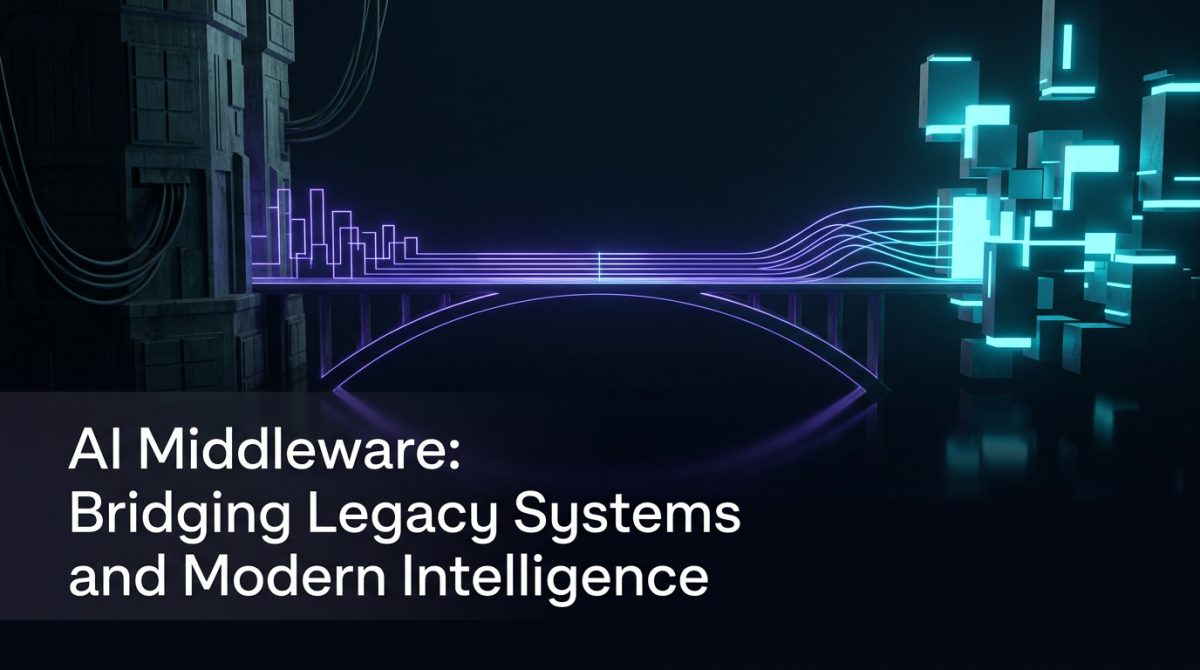
AI middleware sits between your existing systems and modern AI capabilities. It handles translation, orchestration, and data movement so your legacy platforms do not need to understand how a large language model works, and your AI layer does not need to know the quirks of your 15-year-old database schema.
Think of it as a purpose-built adapter layer with three core responsibilities:
- Data normalisation - transforming inconsistent formats, encodings, and structures into something AI models can process reliably
- Protocol bridging - converting legacy communication methods (SOAP, flat files, proprietary APIs) into modern REST or gRPC interfaces
- Context management - maintaining state and session information that legacy systems were never designed to track
The distinction worth drawing here is between general-purpose integration platforms and AI-specific middleware. Tools like MuleSoft or Azure Integration Services handle the first two jobs reasonably well. What they do not do natively is manage prompt construction, handle model versioning, route requests to appropriate models based on content type, or deal with the latency and retry logic that AI inference introduces. You need both layers working together, or a middleware layer purpose-built to handle all of it.
The Data Problem Nobody Talks About Enough
Before you write a single line of integration code, you need an honest audit of what your legacy systems actually produce. This is where most AI integration projects run into trouble.
Legacy systems were built to store and retrieve data, not to feed it to probabilistic models. Common issues include:
- Encoding inconsistencies - a single customer database might contain UTF-8, Latin-1, and Windows-1252 encoded strings across different tables, depending on when records were created
- Implicit business logic in data - a status code of "7" in your old ERP might mean something specific that was never documented anywhere except in the head of a developer who left in 2016
- Temporal gaps - records updated in batch processes every 24 hours will produce stale context for any real-time AI feature
- Schema drift - columns repurposed over time to hold data they were not designed for
A practical first step is building a data lineage map for every field you plan to feed into your AI layer. This is not glamorous work, but skipping it produces AI middleware for legacy systems that technically runs but produces outputs your users cannot trust.
For encoding issues specifically, a normalisation step in your middleware pipeline should be non-negotiable. Here is a minimal example of what that looks like in Python before data reaches your AI layer:
def normalise_legacy_record(raw_record: dict) -> dict:
    normalised = {}
    for key, value in raw_record.items():
        if isinstance(value, bytes):
            # Attempt UTF-8 first, fall back to Latin-1
            try:
                normalised[key] = value.decode('utf-8')
            except UnicodeDecodeError:
                normalised[key] = value.decode('latin-1')
        elif isinstance(value, str):
            normalised[key] = value.strip()
        else:
            normalised[key] = value
    return normalised
This is a starting point, not a complete solution. Real implementations need logging, error handling, and field-level validation on top of this.
Choosing Your Integration Architecture
There are three common architectural patterns for AI middleware with legacy systems, each with different trade-offs.
Synchronous Pass-Through
The legacy system makes a call, middleware transforms the request, sends it to the AI service, transforms the response, and returns it. Simple, easy to debug, but introduces latency directly into your user-facing workflows. Acceptable for back-office processes. Problematic for anything customer-facing where response time matters.
Asynchronous Event-Driven
Legacy systems emit events (file drops, database triggers, message queue entries) that middleware picks up and processes independently. AI results are written back to a staging area the legacy system polls or reads from. This pattern decouples the systems properly and handles the latency of AI inference without blocking anything. The trade-off is complexity in managing state and handling failures across an asynchronous boundary.
Batch Processing Pipeline
Legacy systems export data on a schedule, middleware processes it through AI models, and enriched data is loaded back. This suits use cases like document classification, customer segmentation, or anomaly detection where real-time is not required. It is also the most forgiving pattern when you are still building confidence in your AI outputs, because you can review results before they affect anything downstream.
Most organisations end up running all three patterns simultaneously for different use cases. Design your middleware layer to support this from the start rather than bolting on additional patterns later.
A Concrete Example: Claims Processing at a Regional Insurer
A regional insurance business was processing claims through a policy management system built in the early 2000s. The system had no API - data came out as fixed-width text files dropped to a network share every four hours. They wanted to use an LLM to assist claims assessors by summarising claim history and flagging potentially related prior claims.
The middleware solution they built had the following components:
- A file watcher service that detected new exports and triggered processing
- A parser that converted fixed-width records into structured JSON, with a lookup table mapping legacy status codes to human-readable descriptions
- A context assembly step that grouped related records by policy number and constructed a structured prompt
- An inference service calling a hosted LLM via API, with retry logic and a circuit breaker to handle rate limits
- A results writer that stored AI-generated summaries in a separate database the claims portal could query
The legacy system was not touched. No vendor engagement was required. The total integration surface was the file export, which the legacy system had always produced. Claims assessors started seeing AI-generated summaries within six weeks of the project starting.
This is what effective AI middleware for legacy systems looks like in practice - working around the constraints of what exists rather than demanding changes that will take 18 months to negotiate.
Handling Failure Gracefully
AI services fail. They return unexpected outputs. They hit rate limits. They go through model updates that change behaviour. Your middleware layer needs to treat all of this as expected operational reality, not edge cases.
Specific patterns worth implementing:
- Graceful degradation - if the AI layer is unavailable, the legacy system should continue functioning without it. The AI enhancement is additive, not load-bearing
- Output validation - define what a valid AI response looks like for each use case and reject responses that do not meet the criteria before they reach downstream systems
- Versioned prompt management - store prompts in version control and treat changes to them with the same discipline as code changes. A prompt change is a behaviour change
- Audit logging - log every input sent to an AI model and every output received, with timestamps. This is essential for debugging, compliance, and identifying model drift over time
The audit logging point is particularly important for Australian organisations operating under privacy legislation. If personal information is being processed through an AI layer, you need to be able to demonstrate what was sent where and when.
Security and Data Residency Considerations
Sending data from a legacy system through middleware to an AI service introduces new data flows that your existing security controls may not cover.
Key questions to resolve before going to production:
- Where does inference happen? Cloud-hosted models may process data outside Australia. For sensitive industries - health, finance, government - this requires explicit assessment against your data handling obligations
- What data is actually necessary? Apply data minimisation at the middleware layer. If the AI use case requires a customer's claim history, it probably does not also need their date of birth and home address
- How are credentials managed? Legacy systems often have weak credential management. Your middleware layer should not inherit those weaknesses - use a secrets manager and rotate API keys regularly
- Is the middleware layer itself secured? An integration layer that sits between systems is a high-value target. Treat it accordingly with network segmentation, access controls, and monitoring
For organisations in regulated sectors, getting your security and privacy team involved at architecture design time - not at go-live - will save significant rework.
What to Do Next
If you are looking at an AI initiative that involves existing systems, start here:
- Audit your data outputs - understand exactly what your legacy systems produce, in what format, on what schedule, and with what quality characteristics before designing anything
- Pick one use case - choose something with clear value, bounded scope, and tolerance for an asynchronous delivery pattern. Do not start with anything customer-facing or business-critical
- Build the middleware layer as a product - not a one-off script. It will be reused. Design it with logging, error handling, and configuration management from the start
- Plan for model changes - the AI models you integrate with today will change. Build your middleware to abstract the model layer so you can swap providers or versions without rewriting your integration logic
If you want a technical assessment of your current systems and a realistic integration roadmap, get in touch with the Exponential Tech team. We work with Australian organisations on exactly these problems - not the theoretical version, but the version where the legacy system has not been documented since 2011 and the original developer is unreachable.
Frequently Asked Questions
Q: What is AI middleware and why do legacy systems need it?
AI middleware sits between your existing legacy systems and modern AI capabilities, handling data translation, protocol bridging, and context management so neither side needs to understand the other's technical quirks. Legacy systems were built to store and retrieve data, not to feed probabilistic AI models, so a dedicated middleware layer is essential to make the two work together reliably. Without it, you are either forced into a costly system replacement or left with AI integrations that technically run but produce outputs users cannot trust.
Q: Do we need to replace or modify our legacy systems to add AI capabilities?
In most cases, no - effective AI middleware works around the constraints of existing systems rather than demanding changes to them. The regional insurer example in this article added LLM-powered claims summaries without touching the legacy policy management system at all, working entirely from the fixed-width file exports it already produced. This approach avoids lengthy vendor negotiations and can deliver working AI features within weeks rather than months or years.
Q: What are the main risks when integrating AI with legacy systems?
The most common risks are poor data quality from legacy systems - including encoding inconsistencies, undocumented status codes, and schema drift - and failure to account for AI service outages or unexpected outputs. Australian organisations also need to consider data residency obligations, since cloud-hosted AI models may process data outside Australia, which requires explicit assessment for regulated industries such as health, finance, and government. Building graceful degradation, output validation, and thorough audit logging into your middleware layer from the start mitigates most of these risks.
Q: Which integration architecture pattern is best for AI middleware with legacy systems?
The right pattern depends on your use case: synchronous pass-through suits back-office processes where simplicity matters, asynchronous event-driven works well when you need to decouple systems and handle AI inference latency, and batch processing pipelines are ideal for use cases like document classification or customer segmentation where real-time delivery is not required. Most organisations end up running all three patterns simultaneously for different workflows, so it is worth designing your middleware layer to support all of them from the outset rather than retrofitting additional patterns later.