The Gap Between Good Intentions and Actual Practice
Most Australian organisations now have some form of AI ethics statement. They reference fairness, transparency, accountability. The documents look good in board presentations. Then the development team ships a model that nobody can explain, trained on data nobody has audited, making decisions that affect real people.
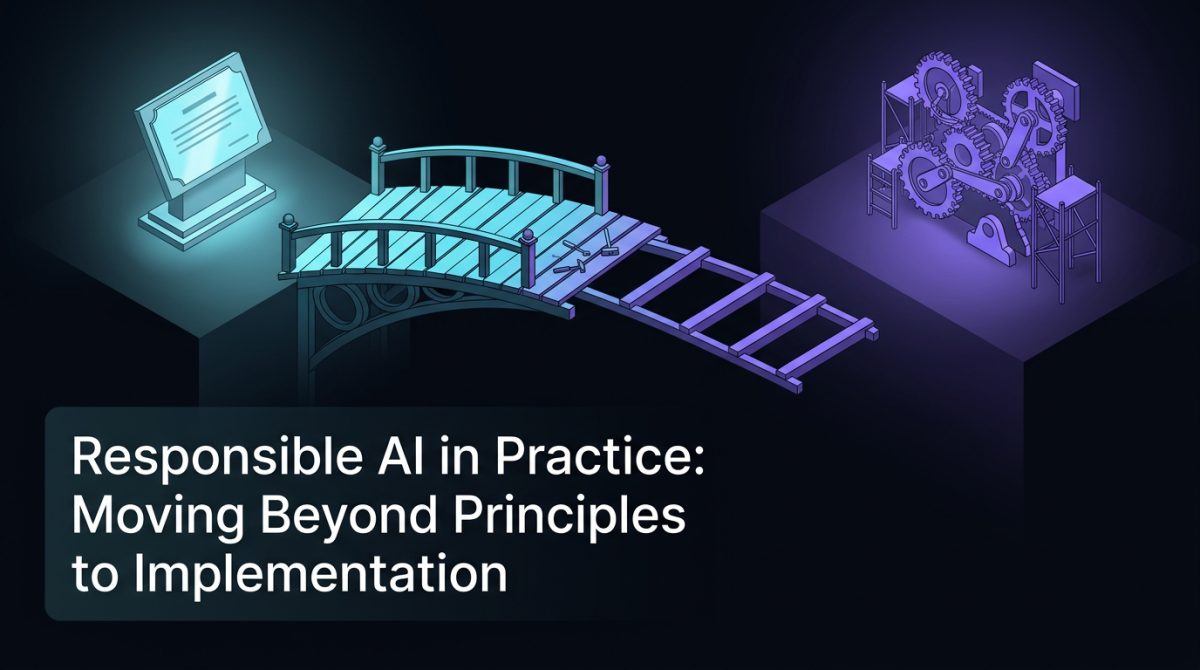
This is the responsible AI implementation problem in its most common form - not a shortage of principles, but a failure to translate them into engineering decisions, procurement requirements, and operational controls.
The gap is expensive. Regulatory exposure under Australia's evolving AI governance landscape is real. The reputational damage from a high-profile AI failure is real. And the operational cost of retrofitting safety controls into a system that was never designed to accommodate them is substantially higher than building them in from the start.
This article covers what responsible AI implementation actually looks like when it moves from a policy document into day-to-day practice.
Start With a Risk Classification, Not a Values Statement
Before any AI project begins, someone needs to answer a straightforward question: what happens when this system makes a wrong decision?
If the answer is "a product recommendation is slightly off," the risk profile is low. If the answer is "a person is denied a loan, flagged for fraud, or removed from a benefits programme," you are operating in a high-stakes environment that requires substantially different controls.
The EU AI Act uses a tiered risk framework. Australia's National Framework for the Assurance of Artificial Intelligence in Government points in a similar direction. Both approaches share a practical insight: the level of scrutiny applied to an AI system should be proportional to the severity and reversibility of its potential harms.
In practice, this means building a risk classification step into your project intake process. Before a team begins scoping an AI solution, they complete a structured assessment covering:
- Who is affected by the system's outputs, and do they have meaningful recourse if something goes wrong?
- What data is being used, and does it carry historical bias or privacy risk?
- How automated is the decision pathway - is there human review before consequential action is taken?
- What are the failure modes - does the system fail silently, or are errors visible and correctable?
This classification then determines what governance controls are mandatory. Low-risk systems might require basic documentation and a post-deployment review. High-risk systems require bias testing, explainability requirements, audit logging, and defined escalation paths.
Data Governance Is Not a Separate Workstream
One of the most common structural mistakes in responsible AI implementation is treating data governance as something the data team handles while the AI team builds the model. In practice, these two workstreams are inseparable.
A model is only as fair as the data it was trained on. A model is only as reliable as the data quality controls applied upstream. And a model is only as auditable as the lineage documentation that tracks where the training data came from, how it was processed, and what was excluded.
Consider a concrete example. A financial services organisation builds a credit risk model using historical loan approval data. That historical data reflects past lending decisions - decisions that may have systematically disadvantaged certain demographic groups. If the team trains on this data without examining its composition, they are not building a neutral system. They are automating historical bias and calling it objective.
Responsible AI implementation requires that data teams and model teams work from a shared checklist that covers:
- Data provenance - documented source, collection method, and any known limitations
- Demographic representation - whether the training data reflects the population the model will be applied to
- Label quality - whether the outcomes used to train the model are themselves reliable and unbiased
- Temporal validity - whether the data is recent enough to reflect current conditions
This is not abstract ethics work. It is engineering hygiene that directly affects model performance and legal defensibility.
Explainability Has to Be Fit for Purpose
"Explainable AI" is one of the most overused phrases in the field. It gets applied to everything from a simple feature importance chart to a full causal audit trail. The problem is that different stakeholders need different types of explanation, and conflating them leads to systems that satisfy nobody.
A data scientist reviewing model behaviour needs technical explainability - SHAP values, partial dependence plots, confusion matrices broken down by demographic subgroup. This helps them identify where the model is underperforming and why.
A compliance officer needs process explainability - documentation of how the model was developed, what tests were run, what risks were identified, and how they were mitigated. This supports regulatory review and audit.
A customer who has been denied a service based on an automated decision needs outcome explainability - a plain-language account of what factors influenced the decision and what they can do about it. Under Australia's Privacy Act and emerging consumer protection frameworks, this is increasingly a legal requirement, not just a courtesy.
Building explainability into a system means deciding upfront which audiences need what, and designing accordingly. A post-hoc explanation layer bolted onto a black-box model is rarely sufficient for high-stakes applications. For those use cases, model architecture choices made during development - choosing interpretable models where performance trade-offs are acceptable, or constraining more complex models with interpretability requirements - are the more defensible approach.
Human Oversight Needs to Be Genuine, Not Theatrical
Many AI systems include a "human in the loop" as a stated control. In practice, the human is reviewing 200 decisions per hour with no practical ability to question the model's output. This is not oversight. It is liability transfer.
Genuine human oversight in responsible AI implementation means designing review processes where the human reviewer has:
- Sufficient time to meaningfully assess each case
- Access to the information the model used to reach its conclusion
- The authority and training to override the model when they have good reason to
- Feedback mechanisms that route their overrides back into model improvement
This has real operational implications. It means staffing decisions, training programmes, and workflow design are all part of the AI governance picture. It also means being honest about where genuine oversight is not operationally feasible - and either accepting that the system requires a different architecture, or accepting the risk that comes with fully automated decision-making.
One useful test: if a regulator asked your reviewers to demonstrate their oversight process, could they show a clear audit trail of decisions reviewed, overrides made, and the reasoning behind those overrides? If the answer is no, the oversight process needs redesign.
Monitoring After Deployment Is Where Most Programmes Fail
Responsible AI implementation does not end at go-live. Model performance degrades. Data distributions shift. The world changes in ways that make a model trained twelve months ago less reliable today. Without ongoing monitoring, organisations discover these problems through failures rather than through detection.
The minimum viable monitoring programme for any AI system in production includes:
- Performance metrics tracked over time, with defined thresholds that trigger review
- Fairness metrics monitored across demographic subgroups, not just in aggregate
- Data drift detection that flags when input distributions have moved significantly from training conditions
- Incident logging that captures cases where the system produced unexpected or disputed outputs
For high-risk systems, monitoring should also include periodic adversarial testing - deliberately probing the system for failure modes, including edge cases and inputs that were not well-represented in training data.
The organisational question is who owns this monitoring function. In many organisations, the model development team hands off to an operations team that lacks the technical context to interpret what they are seeing. Building a clear handover process, with documented thresholds and escalation paths, is as important as the monitoring infrastructure itself.
Procurement Is a Governance Lever You Are Probably Not Using
A significant proportion of AI systems used in Australian organisations are not built in-house. They are purchased from vendors, integrated via API, or deployed as part of larger software platforms. Responsible AI implementation has to extend to these systems, which means procurement is a governance lever.
Before purchasing or integrating an AI system, organisations should require vendors to provide:
- Model cards or equivalent documentation describing what the system does, what it was trained on, and what its known limitations are
- Bias and fairness testing results relevant to the use case
- Audit and logging capabilities that allow the purchasing organisation to maintain oversight
- Contractual commitments around data handling, model updates, and incident notification
This is not a novel concept. It is standard practice in mature technology procurement - the same diligence applied to security controls should be applied to AI governance. The challenge is that many procurement teams do not yet have the technical fluency to ask the right questions, and many vendors are not yet accustomed to answering them. Both of those conditions are changing as regulatory pressure increases.
What to Do Next
If your organisation is at the stage of having AI principles but not yet a consistent implementation approach, the practical starting point is not a policy rewrite. It is an audit of what you already have.
Map your current AI systems. Identify every system that uses machine learning or automated decision-making, regardless of whether it was built internally or purchased. Note what decisions it influences, who is affected, and what monitoring is currently in place.
Apply a risk classification. Use a simple tiered framework to categorise each system by the severity of its potential harms. This will quickly surface which systems warrant immediate attention and which can be managed with lighter-touch controls.
Identify your biggest gap. For most organisations, the gap is either in data governance, post-deployment monitoring, or human oversight processes. Pick the highest-risk system and fix the most significant gap first before attempting a programme-wide overhaul.
Build the capability, not just the policy. Responsible AI implementation requires people who understand both the technical and the governance dimensions. Invest in training for your data and engineering teams, and consider whether you have the right expertise in your procurement and compliance functions.
Exponential Tech works with Australian organisations on practical AI governance - from risk classification frameworks to monitoring programme design. If you are working through any of these challenges, get in touch.
Frequently Asked Questions
Q: What is the difference between having AI ethics principles and responsible AI implementation?
Having AI ethics principles means documenting values like fairness and transparency, but implementation means translating those principles into engineering decisions, procurement requirements, and operational controls. Most Australian organisations have the former but struggle with the latter. The gap creates real regulatory, reputational, and operational risk.
Q: How should organisations classify the risk level of an AI system?
Organisations should assess what happens when the system makes a wrong decision, considering who is affected, whether they have recourse, how automated the decision pathway is, and what the failure modes look like. The level of scrutiny and governance controls applied should be proportional to the severity and reversibility of potential harms. Low-risk systems may need only basic documentation, while high-risk systems require bias testing, explainability requirements, and audit logging.
Q: Why is post-deployment monitoring so important for responsible AI?
Model performance degrades over time as data distributions shift and real-world conditions change, meaning a model trained twelve months ago may be significantly less reliable today. Without ongoing monitoring, organisations tend to discover these problems through failures rather than through proactive detection. A minimum viable monitoring programme should track performance metrics, fairness metrics across demographic subgroups, data drift, and incident logs.
Q: How does responsible AI implementation apply to AI systems purchased from vendors?
Procurement is a governance lever that many organisations are not yet using effectively, even though a significant proportion of AI systems are purchased rather than built in-house. Organisations should require vendors to provide model documentation, bias and fairness testing results, audit and logging capabilities, and contractual commitments around data handling and incident notification. The same diligence applied to security controls in technology procurement should be applied to AI governance.