The Cost of Waiting for Things to Break
A conveyor belt stops at 2am on a Tuesday. By the time a technician arrives, diagnoses the fault, and waits for a replacement bearing to be shipped, you've lost 14 hours of production. The bearing itself costs $40. The downtime costs $180,000.
This scenario plays out across Australian manufacturing, mining, utilities, and logistics operations every week. The equipment failure wasn't sudden - the bearing had been degrading for weeks, generating heat signatures, vibration anomalies, and subtle changes in motor current draw. All of that data existed. Nobody was watching it.
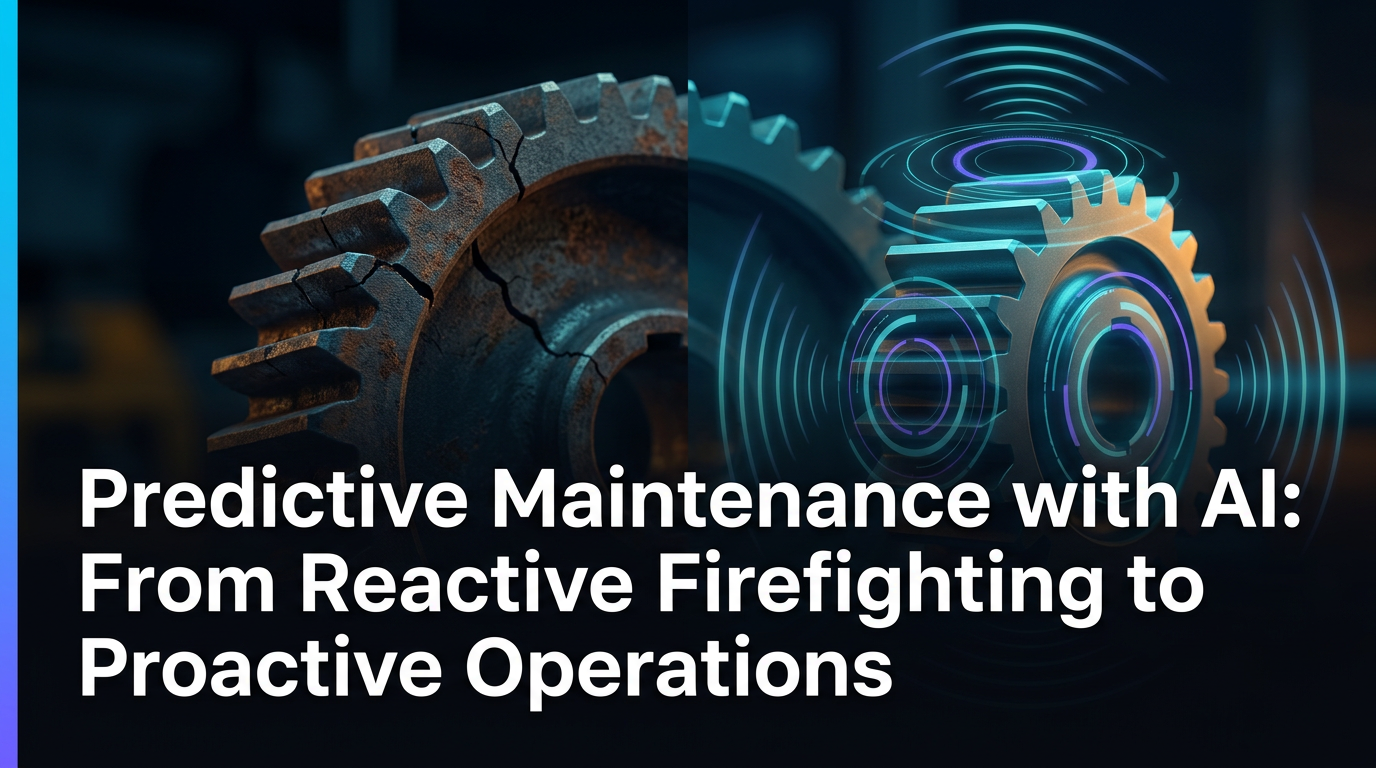
Predictive maintenance AI changes that equation. Instead of reacting to failures after they happen, or replacing components on arbitrary schedules regardless of actual condition, organisations can monitor equipment continuously and intervene precisely when the data says intervention is needed. The result is less unplanned downtime, lower maintenance costs, and longer asset life.
This article explains how predictive maintenance AI actually works in practice, what data you need to make it function, and how Australian organisations are implementing it without requiring a complete overhaul of existing infrastructure.
What Predictive Maintenance AI Actually Does
The term gets used loosely, so it's worth being specific. Predictive maintenance AI refers to machine learning models trained to detect anomalies and forecast failures in physical equipment by analysing sensor data, operational logs, and maintenance records over time.
The core workflow looks like this:
- Data collection - Sensors on equipment capture temperature, vibration, pressure, current draw, acoustic emissions, or whatever physical signals are relevant to the failure modes you care about
- Feature engineering - Raw sensor readings are transformed into meaningful signals: rolling averages, rate-of-change metrics, frequency domain features from vibration data, and so on
- Model training - Machine learning algorithms learn what normal operating behaviour looks like for each asset, and what patterns precede known failure events
- Inference and alerting - Deployed models score incoming data in near real-time, flagging anomalies and generating alerts when equipment behaviour deviates from baseline
The output isn't a prediction in the vague sense. It's a specific alert: "Pump 7 in Building C is showing bearing wear consistent with failure within 72-120 hours. Recommended action: schedule replacement during the next planned maintenance window."
That kind of specificity is what separates useful predictive maintenance AI from a dashboard full of sensor readings that nobody acts on.
The Data Foundation You Need
Before any model gets built, you need honest answers to a few data questions. Many predictive maintenance projects stall here because organisations discover their data infrastructure isn't as mature as they assumed.
What sensors do you have, and how reliable is the data?
Sensor coverage varies enormously. Some facilities have comprehensive IoT instrumentation; others rely on monthly manual readings entered into a spreadsheet. The more frequent and automated your data collection, the more accurate your models will be. Hourly readings can detect gradual degradation. Once-a-week readings often can't.
Do you have labelled failure history?
Machine learning models learn from examples. If you want a model to recognise bearing failure signatures, you need historical cases where bearings failed, along with the sensor data that preceded those failures. Organisations with good CMMS (Computerised Maintenance Management System) records have this. Those without structured maintenance history face a longer path to useful models.
Is your data clean and consistent?
Sensor drift, communication dropouts, and inconsistent equipment tagging are common. A pump labelled "P-7" in one system and "Pump07" in another creates data alignment problems that have to be resolved before modelling can begin. This data cleaning work is unglamorous but non-negotiable.
A realistic assessment of your data maturity will tell you how quickly you can expect results and where investment in data infrastructure needs to happen first.
A Concrete Example: Rotating Equipment in a Mineral Processing Plant
Consider a mineral processing operation running 40 slurry pumps across a facility. These pumps run continuously, handling abrasive material that accelerates wear on impellers, seals, and bearings. Historically, the maintenance team replaced components on a fixed 1,000-hour schedule regardless of actual condition, and still experienced roughly eight unplanned failures per year.
The predictive maintenance AI implementation involved:
- Installing vibration and temperature sensors on all 40 pumps, feeding data into a centralised historian at 10-second intervals
- Pulling three years of maintenance records from the CMMS to identify historical failure events and the sensor patterns that preceded them
- Training anomaly detection models on each pump's baseline behaviour, accounting for the fact that different pumps run at different loads and handle different feed materials
- Deploying the models to generate daily health scores for each pump, with alerts triggered when scores dropped below defined thresholds
Within the first six months, the system identified seven pumps showing early-stage bearing degradation that wouldn't have been caught until the next scheduled inspection. Maintenance teams were able to schedule replacements during planned shutdowns rather than scrambling during production hours.
The outcome: unplanned failures dropped from eight per year to one in the following 12 months, and component replacement intervals were extended on pumps showing healthy condition scores, reducing unnecessary parts consumption by roughly 23%.
The technology wasn't exotic. The value came from connecting existing operational data to a model that could watch all 40 pumps simultaneously and flag the ones that needed attention.
Choosing the Right Approach for Your Operation
Not every organisation needs a custom-built machine learning platform. The right approach depends on your asset complexity, data maturity, and internal capability.
Off-the-shelf condition monitoring tools
Several vendors offer packaged predictive maintenance solutions for specific equipment types - motors, compressors, conveyor systems. These tools come with pre-built models and require less data science capability to deploy. They work well when your equipment matches the vendor's assumptions and you don't need customisation.
Cloud-based ML platforms with pre-built components
Platforms like AWS IoT SiteWise, Azure IoT Hub, or Google Cloud's industrial AI offerings provide infrastructure for ingesting sensor data and running anomaly detection models. They reduce the infrastructure burden but still require data engineering and some model configuration work.
Custom model development
For complex assets with unique failure modes, or organisations with significant data science capability, building custom models using frameworks like Python's scikit-learn, TensorFlow, or PyTorch gives maximum flexibility. This approach takes longer to deploy but can handle nuanced failure patterns that generic tools miss.
The honest recommendation: start with the simplest approach that addresses your highest-value failure modes. A well-configured off-the-shelf tool that prevents two major failures per year is more valuable than a sophisticated custom platform that takes 18 months to deploy.
Integration with Maintenance Workflows
Predictive maintenance AI generates no value if the alerts it produces don't result in action. This is where many implementations fall short - technically sound models feed alerts into a system that nobody is monitoring, or generate so many notifications that technicians start ignoring them.
Effective integration requires:
Alert routing that matches operational reality. Alerts need to reach the right person at the right time through channels they actually use - whether that's a CMMS work order, an SMS to a shift supervisor, or a flag in an operator dashboard. Alerts that land in an email inbox nobody checks are wasted.
Tiered severity levels. Not every anomaly requires immediate action. A well-designed system distinguishes between "monitor closely" signals, "schedule maintenance within two weeks" signals, and "stop the equipment now" signals. Flooding technicians with low-priority alerts creates alert fatigue and degrades response to genuine high-priority events.
Feedback loops back into the model. When a technician investigates an alert and finds either a genuine fault or a false positive, that outcome should be recorded and fed back to improve model accuracy over time. Without this feedback loop, models don't improve and trust in the system erodes.
Workforce buy-in. Maintenance technicians who've spent 20 years learning to read equipment by sound and feel can be sceptical of AI-generated alerts. Involving them in the implementation, explaining how the models work, and demonstrating early wins builds the trust that makes the system actually function.
Measuring Whether It's Working
Predictive maintenance AI is an investment, and like any investment it needs to be measured. The metrics that matter most are:
- Mean Time Between Failures (MTBF) - Is it increasing for instrumented assets?
- Unplanned downtime hours - Is the frequency and duration of unplanned outages decreasing?
- Maintenance cost per asset - Are you spending less on emergency repairs and unnecessary preventive replacements?
- Alert accuracy - What percentage of alerts result in a confirmed fault? High false positive rates indicate model tuning is needed.
- Lead time before failure - How far in advance are failures being detected? More lead time means more scheduling flexibility.
Establish baseline measurements before deployment so you have something to compare against. A 12-month post-implementation review against those baselines will tell you whether the investment is generating real returns or whether the implementation needs adjustment.
What to Do Next
If predictive maintenance AI is on your radar but you're not sure where to start, these steps will move you from consideration to action:
-
Identify your highest-cost failure modes. Pick the two or three equipment failures that cause the most downtime or the most expensive emergency repairs. These are your priority use cases.
-
Audit your existing data. Pull sensor coverage, data quality, and maintenance history for those assets. Be honest about gaps - they'll surface during implementation anyway.
-
Start with a pilot, not a platform. Choose one asset class, instrument it properly, and build a working model before investing in enterprise-wide deployment. A successful pilot builds internal confidence and surfaces integration challenges at manageable scale.
-
Define success criteria upfront. Agree on what metrics you'll use to evaluate the pilot and what improvement threshold justifies broader rollout.
-
Talk to an implementation partner with operational experience. Predictive maintenance AI sits at the intersection of data science, industrial systems, and maintenance operations. The projects that succeed have people involved who understand all three domains.
The technology is mature and the ROI case is well established. The gap between organisations that have implemented predictive maintenance AI successfully and those still replacing bearings on fixed schedules isn't technical capability - it's the decision to start.
Further Reading
- why most AI projects fail to reach production
- build an AI champions program
- AI implementation services in Australia
Frequently Asked Questions
Q: What is predictive maintenance AI and how does it differ from traditional maintenance?
Predictive maintenance AI uses machine learning models to continuously analyse sensor data, operational logs, and maintenance records to detect anomalies and forecast equipment failures before they occur. Unlike traditional reactive maintenance (fixing things after they break) or scheduled preventive maintenance (replacing components on fixed intervals regardless of condition), predictive maintenance AI intervenes precisely when data indicates it is needed, reducing both unplanned downtime and unnecessary parts replacement.
Q: What data do you need to implement predictive maintenance AI?
You need reliable sensor data (such as temperature, vibration, pressure, and current draw), labelled failure history from a Computerised Maintenance Management System (CMMS), and clean, consistently tagged data across your systems. The more frequent and automated your data collection, the more accurate your models will be - hourly readings can detect gradual degradation that weekly manual readings often miss.
Q: How long does it take to see results from a predictive maintenance AI implementation?
Results depend on your data maturity and the approach you choose, but a well-executed pilot focused on high-priority assets can surface actionable insights within the first few months of deployment. In one mineral processing example, the system identified seven pumps with early-stage bearing degradation within the first six months, reducing unplanned failures from eight per year to one over the following 12 months.
Q: Do you need to replace your existing infrastructure to implement predictive maintenance AI?
Not necessarily - many successful implementations build on existing sensors, historians, and CMMS records rather than requiring a complete overhaul. Starting with the simplest approach that addresses your highest-value failure modes, such as an off-the-shelf condition monitoring tool or a cloud-based ML platform, is often more practical and delivers faster returns than building a custom platform from scratch.