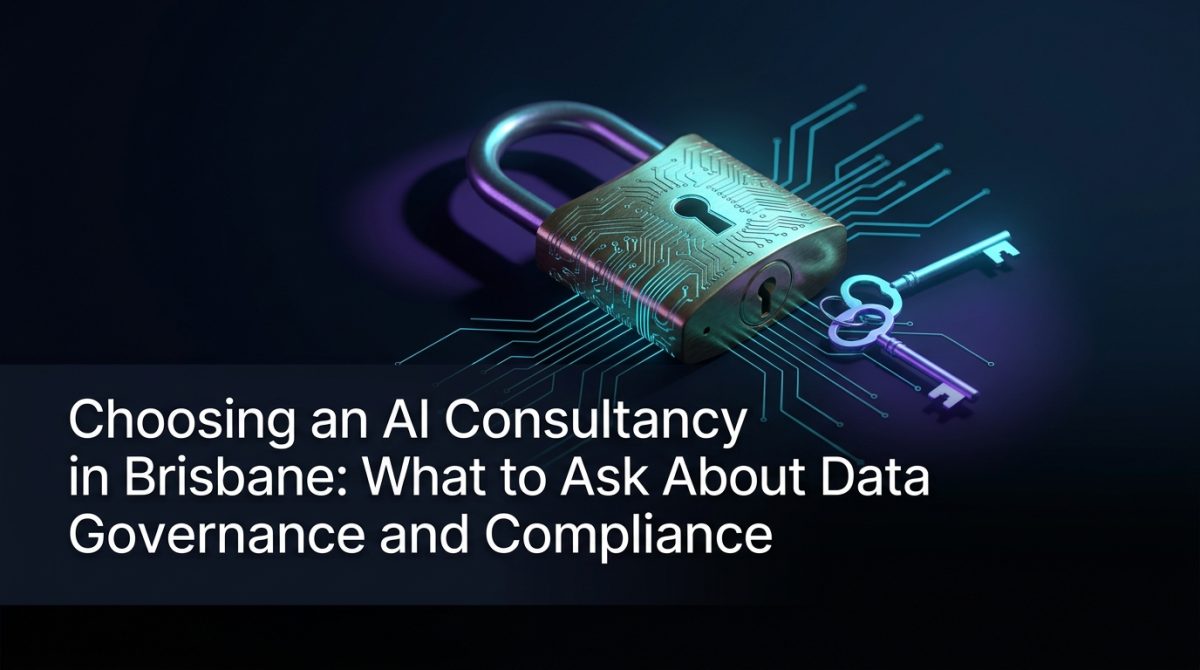
The Problem Most Brisbane Businesses Don't See Until It's Too Late
Sarah runs a 45-person FinTech startup in Brisbane. Last Tuesday, her head of product demoed a new AI-powered loan assessment tool to the board. The demo went well. Then the CFO asked a single question: "Where does the customer data go when it's processed?"
Nobody in the room had a clear answer.
That moment - the silence after a reasonable compliance question - is where most AI projects in regulated industries start to unravel. Choosing the right AI consultancy in Brisbane isn't primarily about which firm has the most impressive demo. It's about which firm can answer that CFO's question clearly, in writing, before the project starts.
This guide gives you the specific questions to ask, what good answers look like, and how to tell when a consultancy is winging it on compliance.
Why Data Governance Is the First Conversation, Not the Last
Data governance refers to the rules, processes, and accountability structures that control how data is collected, stored, used, and deleted inside your organisation and by any third party you engage. In an AI context, this matters because every AI system you build or buy processes data - often sensitive customer data - and Australian law is specific about what that means.
The Privacy Act 1988 and the Australian Privacy Principles (APPs) set out how personal information must be handled. The APPs require that data is collected only for a stated purpose, stored securely, and not sent overseas without adequate protections in place. For a FinTech, you also have obligations under ASIC's regulatory guidance and, depending on your products, APRA's prudential standards.
A credible AI consultancy in Brisbane will raise these obligations in your first scoping conversation. If they don't, that's a signal worth noting.
Ask any prospective consultancy these questions directly:
- Which Australian privacy laws apply to this project, and how does your proposed architecture address them?
- Will any data leave Australia during training, inference (the process of the AI generating an answer), or logging?
- Who has access to our data on your side, and what contractual controls exist?
If the answers are vague, the firm is not the right partner for a regulated environment.
What to Ask About Model Hosting: Local vs Cloud APIs
AI systems generally run in one of two ways. Either the model runs on infrastructure you control (locally hosted or on an Australian cloud region), or your data is sent to a third-party API - such as OpenAI's GPT-4 or Anthropic's Claude - where it is processed on overseas servers.
Both approaches are legitimate. The choice depends on your data sensitivity, budget, and capability requirements.
Here is a practical comparison:
| Factor | Locally Hosted / Open-Weight Model | Frontier API (e.g. OpenAI, Anthropic) |
|---|---|---|
| Data residency | Stays on your infrastructure | Processed overseas (US data centres) |
| Monthly cost (AUD) | $2,000-$8,000+ in compute costs | $500-$5,000+ in API fees, depending on volume |
| Capability | Strong for focused tasks; weaker on complex reasoning | Best-in-class reasoning and language quality |
| Effort to run | Requires ongoing model management | Minimal ops overhead |
| Privacy control | Full control | Subject to provider's data handling terms |
| When it wins | Sensitive data, regulated industries, high-volume internal tools | Rapid prototyping, lower-sensitivity use cases, complex reasoning tasks |
For a FinTech handling customer financial data, local hosting or an Australian-region deployment (AWS Sydney, Azure Australia East) is often the appropriate starting point. A good AI advisory services provider in Brisbane will model this tradeoff for your specific use case rather than defaulting to whichever option is easiest for them to implement.
What This Looks Like in Practice
Here is a worked example based on a realistic scenario.
The team: A 12-person operations team at a Brisbane-based lending company. They want an AI tool that reads customer documents and extracts key financial details to pre-fill loan applications.
The tools: A locally hosted version of Mistral 7B (an open-weight language model - meaning the model weights are publicly available and can be run on your own servers), deployed on AWS Sydney. A document parsing pipeline built with LangChain (a framework for connecting AI models to data sources). A simple web interface for the ops team.
Timeline: 10 weeks from scoping to production. Weeks 1-2 were governance and architecture review. Weeks 3-6 were build and testing. Weeks 7-10 were user acceptance testing and security review.
Cost: Approximately $65,000-$85,000 AUD for the initial build, including model infrastructure setup, integration with the existing loan management system, and a compliance documentation package.
What went wrong: The initial model struggled with handwritten documents and non-standard PDF formats. The team had underestimated how variable the incoming document quality would be. This added two weeks to testing and required a pre-processing step (an automated document cleaning layer) that was not in the original scope. Budget increased by approximately $12,000.
The lesson: document quality is almost always messier than expected. A consultancy that builds in a document audit before scoping will save you this problem.
How to Evaluate a Consultancy's AI Governance Approach
Step 1: Ask for their governance framework documentation. A firm that does this regularly will have a written framework they can share. It should reference the Australian Privacy Principles, the EU AI Act (relevant if you have European customers), and ideally NIST's AI Risk Management Framework.
Step 2: Ask how they handle model explainability. Explainability means the ability to describe, in plain terms, why an AI system made a particular decision. For credit decisions or customer-facing outputs, this is both a legal requirement and a practical necessity. Ask: "If this model makes a decision that a customer disputes, how do we explain it?"
Step 3: Ask about audit logging. Every action the AI system takes should be logged - what input it received, what output it produced, and when. Ask to see a sample logging schema from a previous project.
Step 4: Ask who owns the model and the data after the engagement ends. Some consultancies retain rights to models they build on your data. You want clear contractual language that the trained model, the training data, and all outputs are your intellectual property.
Step 5: Ask about ongoing monitoring. AI models degrade over time as real-world data drifts away from the data they were trained on. This is called model drift. Ask how the consultancy proposes to detect and address this after go-live.
Is This Right for You?
Do this now if: You are handling customer data in a regulated industry (financial services, health, legal), you have a defined use case with clear inputs and outputs, and you have internal stakeholder buy-in for a 10-16 week project.
Wait if: Your data is not yet centralised or well-structured, or you have not yet defined what problem you are solving. AI systems amplify the quality of your data - good data in, good results out; messy data in, unreliable results out.
What has to be true first: You need a clear data inventory (a list of what data you hold, where it lives, and who can access it), executive sponsorship, and a nominated internal owner for the project. Without these, even the best AI consulting engagement will stall.
What to Do Next
If you are evaluating AI consulting firms in Brisbane, start with a governance-first conversation. Bring your CFO's question to the first meeting and see how the firm responds. The answer tells you more than any capability deck.
At Exponential Tech, our AI strategy and governance work starts with a data and compliance review before any model selection or build begins. That sequence matters - architecture decisions made without governance input are expensive to reverse.
You can also use our ROI calculator to build a realistic business case before committing to a full engagement. It covers implementation cost, ongoing infrastructure, and expected efficiency gains across common use cases.
If you want a direct conversation about your specific situation, contact the team at exponentialtech.ai.
Frequently Asked Questions
Q: What should I ask an AI consultancy in Brisbane about data compliance?
Ask specifically which Australian Privacy Principles apply to your project, whether your data will be processed outside Australia, who on the consultancy's side has access to your data, and what happens to your data and the trained model when the engagement ends. A credible firm answers these questions in writing before the project starts.
Q: What is the difference between locally hosted AI models and cloud API models?
Locally hosted models run on infrastructure you control, keeping your data within your own environment or an Australian cloud region. Cloud API models - such as OpenAI's GPT-4 - process your data on overseas servers. Locally hosted models offer stronger data sovereignty but require more operational effort and typically cost $2,000-$8,000 AUD per month in compute. APIs are faster to deploy and lower in ops overhead but involve data leaving your control.
Q: How much does AI consulting cost in Brisbane?
A scoped AI implementation project with a reputable Brisbane-based consultancy typically ranges from $40,000 to $120,000 AUD depending on complexity, integration requirements, and the level of governance documentation required. Ongoing model monitoring and maintenance adds $2,000-$6,000 AUD per month for most mid-sized deployments.
Q: What is AI governance consulting?
AI governance consulting refers to the advisory and technical work involved in ensuring an AI system is built and operated in compliance with relevant laws, ethical standards, and organisational risk policies. In the Australian context, this includes alignment with the Privacy Act 1988, the Australian Privacy Principles, and any sector-specific regulations such as APRA's prudential standards for financial services. A governance engagement typically produces a risk assessment, a data handling policy, an audit logging framework, and documentation to support regulatory review.